Updated October 2026
The best apps for meeting people while traveling in 2026 are Couchsurfing for stays and events in one app, Hostelworld Social Pass for chat and events, Timeleft and NomadTable for one-off meetups, and Trustroots and BeWelcome for free stays with locals. With a Membership, Couchsurfing gives you free stays with local Hosts who open their homes to Travelers, plus Hangouts, Communities, Events, and Couch Crashes for meeting people wherever you are, all backed by References from other Members.
See what Couchsurfing is about
These apps fit into two groups. The first connects you with locals for a stay in their home: Couchsurfing, Trustroots, and BeWelcome. The second is for meetups and events, where you can socialize without any overnight stay: Hostelworld Social Pass, Timeleft, and NomadTable. Couchsurfing also covers the second group, with Hangouts, Communities, and Events that let you meet people without a stay. It runs on a social reference system, too: any Member can leave References for people they’ve met, whether or not a stay was involved, so you can check a stranger’s track record before you meet.
Best apps for meeting people while traveling, compared
Here is how the apps compare at a glance. Full pros and cons for each app follow.
| App | Best for | Stay with a local? | Cost model |
|---|---|---|---|
| Couchsurfing | Free stays with local Hosts, plus Hangouts, Communities, Events, and Couch Crashes for meeting people | Yes, in a Host’s home. | Paid Membership that includes free Stays with Hosts |
| Hostelworld Social Pass | Chat and events in the Hostelworld app, no hostel booking needed | No | Paid pass, one week to one year |
| Trustroots | Free stays with locals in a smaller, volunteer-run network | Yes | Free |
| BeWelcome | Free stays with locals in a volunteer-run, donation-funded network | Yes | Free |
| Timeleft | One-evening group dinners with strangers | No | Pay to join each dinner; meal extra |
| NomadTable | Real-time meetups and activities for solo travelers | No | Free core features, paid Plus tier |
Couchsurfing
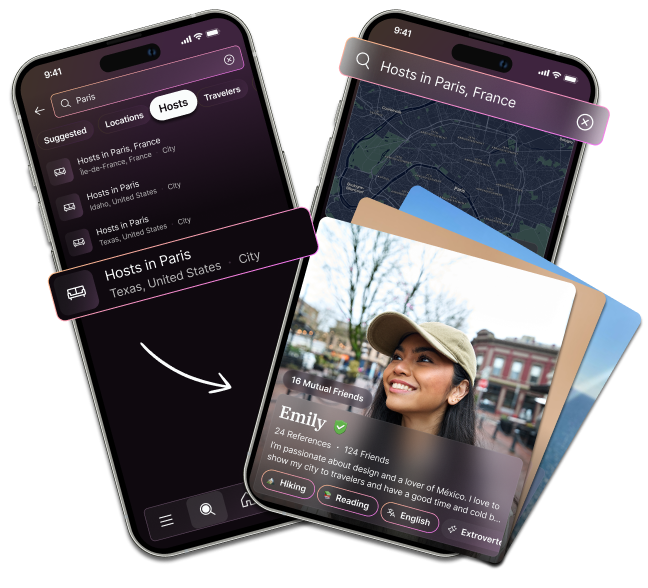
Couchsurfing is an app for meeting people, whether you’re traveling or at home. When you travel, you can find a local Host for a Stay, which means staying in their home for the dates you both agree on. At home, you can host Travelers passing through, or join Hangouts, Events, Communities, and Couch Crashes to meet locals and Travelers in your own city. Every Member has a profile where References appear, so you can see what other Members say about someone before you meet them. Learn how References work. A Membership means a 24/7 Safety & Support team is looking out for a community of millions. It also keeps Couchsurfing ad-free, and Couchsurfing does not sell Member data.
Pros:
- Stays with local Hosts are free with a Membership, and you can send unlimited Stay requests, which are the messages you send a Host to ask if you can stay. Hosts open their homes for cultural exchange, not for money, so you get a real local’s view of their city.
- Safety is our top priority. Every Member can give and get References, whether or not they host or stay, so you can read what other Members say about someone before you meet them. Verification with a government-issued ID is optional, but it can add confidence, and our 24/7 Safety & Support team is there if something feels off.
- Communities, Hangouts, Events, and Member-favorite Couch Crashes give you great ways to meet locals and fellow travelers, at home or on the road, even when no Stay is involved. Location pages, Communities, and Events are free to view without a Membership or logging in, though a Membership unlocks all Event details.
- With more than 25 million registered Members in over 200,000 cities, Couchsurfing reaches destinations around the world, though Host availability varies by city.
Cons:
- A paid Membership is required to access most features, which adds an upfront cost. That cost is what keeps Couchsurfing ad-free and gives you a 24/7 Safety & Support team, because safety comes first.
- Getting a Host to say yes takes effort. A good profile and a personal message to each Host make a big difference. Read this guide to set yourself up for success. Tip: an AI assistant can help you draft a personalized Stay request from a Host’s profile. Read it over, check that any details about the Host are accurate, and make sure it sounds like you before you send it.
- Building up References as a new Member takes time and patience. You can speed it up by requesting Personal References from friends, other Members, and people you meet at Events.
Hostelworld Social Pass
Hostelworld’s Social Pass lets you meet other travelers inside the Hostelworld app, with or without a hostel booking. It’s a pass you buy for a set period that unlocks chat, events, and traveler discovery in your destination. It does not offer home stays, and its traveler profiles list basics like age, languages, bio, and travel stats.
Pros:
- It’s built right into the Hostelworld booking app, so if you already use it to book hostels, there’s nothing extra to download.
- It works without a hostel booking, so it’s useful if you’re staying somewhere else but still want to meet people nearby.
- Getting started takes a few taps inside the app.
Cons:
- It’s a paid pass with a set duration, from one week to one year, so it adds a cost.
- Traveler profiles cover basics like age, languages, and travel stats, and Hostelworld doesn’t describe any traveler feedback, so you have less history to go on.
- It does not offer home stays or the deeper local connections of a hospitality network.
Trustroots
Trustroots is a free, volunteer-run hospitality network. It is smaller and more niche than Couchsurfing, and it is especially popular with hitchhikers and other long-term travelers. Trust is built through profiles and shared experiences from other members. Because the community is smaller, finding a host in many cities can be harder.
Pros:
- Completely free to use. No paid membership required.
- A close, welcoming community with circles for hitchhikers, cyclists, and other traveler groups, which tends to attract experienced travelers.
- Profiles and shared experiences from other members help you decide who to trust, similar to larger networks.
Cons:
- Much smaller than Couchsurfing, so finding a host is harder in many cities.
- The focus on hitchhikers and long-term travelers may not feel like a good fit for casual visitors or short trips.
- Less active moderation and safety features than larger, better-funded platforms.
BeWelcome
BeWelcome is a volunteer-run, member-governed hospitality exchange. Its hosting model works a lot like Couchsurfing’s. It is a good choice in regions where the community is active. In other areas, the smaller membership means availability can be unpredictable.
Pros:
- Fully nonprofit and volunteer-run, with no corporate owners and no membership fees.
- Open-source platform with a transparent, community-governed structure.
- Hosting model closely mirrors Couchsurfing, so the experience feels familiar if you are switching over.
Cons:
- Smaller membership base makes host availability unpredictable in many places.
- It is volunteer-run and funded by donations, so new features and support depend on what its community can take on.
- Finding active hosts in less popular regions can require significant extra effort.
Timeleft
Timeleft organizes small group dinners with strangers in your city. You take a short personality quiz, get matched with five other people, and pay a fee to join each dinner. Your meal at the restaurant costs extra. It is a good option if you want to meet people over one evening. It is not built around stays, hosting, or a way to check someone’s track record. It works best alongside a hospitality network, not instead of one.
Pros:
- Low-pressure way to meet new people over a shared meal with no overnight commitment required.
- Tables are set at six people, you plus five others, matched by an algorithm, which keeps conversations manageable.
- Accessible for solo travelers who want a single evening of genuine social connection.
Cons:
- Not designed for stays with locals or ongoing travel relationships.
- No trust or references system, so you have limited insight into who you will meet beforehand.
- Availability is city-dependent and may be sparse in smaller or less popular destinations.
- It is a paid service, and you pay for your own meal.
NomadTable
NomadTable is an app for solo travelers who want to meet people through shared meals, activities, and short social plans. Core features are free, with a paid Plus tier. It is not built around home stays or a long-term community. It works best as a casual social tool alongside a hospitality network.
Pros:
- Focused specifically on solo travelers, so the community is highly relevant and easy to engage with.
- Shared meals and casual meetups make it easy to break the ice without a large commitment.
- Lightweight and simple to use for quick, spontaneous social plans.
Cons:
- It does not offer stays with locals or a references system, though it has optional profile verification.
- Activity depends on how many travelers are using it in your city.
- Best used as a complement to a hospitality network rather than a standalone travel social tool.
What are the best apps for solo travelers who want to meet people?
The best apps for solo travelers who want to meet people are Couchsurfing for staying with local Hosts, Hangouts, Communities, and Events; Hostelworld Social Pass for chat and events without a hostel booking; Timeleft for group dinners; and NomadTable for real-time meetups. No single app also handles navigation or trip planning, so pair one with a map app and a planner.
Couchsurfing helps with the people part. As a solo Traveler, you can stay with a Host, join a Hangout in the Couchsurfing app (you’ll find Hangouts on the Explore page), or find a Community in the city you’re visiting. More than 25 million registered Members across over 200,000 cities means there is usually someone nearby. Reading a Member’s References before you go gives solo Travelers a way to check who they’re meeting.
Match the app to what you want:
- A local place to stay: Couchsurfing, where you can read a Host’s References before you agree to a stay.
- An open evening to fill: a Couchsurfing Hangout or Event, or a Timeleft dinner.
- A spontaneous meetup: NomadTable.
- Hostel-style socializing, with or without a hostel booking: Hostelworld Social Pass.
- Free stays with locals: Trustroots or BeWelcome, both with smaller communities.
A simple solo kit looks like this:
- Meet people: Couchsurfing for Hosts, Hangouts, Events, and Communities.
- Get around: a map or transit app.
- Stay organized: a trip planner for tickets and bookings.
Here is the honest part. Hosts are not guaranteed in every city. Couchsurfing also comes with a Membership cost, which keeps it ad-free and gives every Member access to safety tools and a 24/7 Safety & Support team. A spare room, a couch, or a whole home will all feel different, and that variety is part of the fun.
What are the best apps for backpackers who want to meet people?
The best apps for backpackers cover three things: a place to sleep, people to meet, and a way to get between stops. For meeting people, Couchsurfing (Host stays, Hangouts, Events, and Communities) and Hostelworld Social Pass (chat and events, no booking needed) suit different stops on the same route. Add a map app and a planner for the logistics.
Couchsurfing fits the “meet locals” part of the trip. Stay with a Host to see a city through their eyes. Join a Hangout in the app when you only have one free evening. Attend an Event or check out a Community to learn what’s happening this week.
Match the app to your route:
- Nights in hostels: Hostelworld Social Pass for chat and events, with or without a hostel booking.
- A stop where you want a local’s view of the city: a Host stay on Couchsurfing.
- One open evening: a Couchsurfing Hangout or Event, or a Timeleft dinner.
- Hitchhiking or a long overland route: Trustroots, which is especially popular with hitchhikers.
- Keeping an eye on cost: Trustroots and BeWelcome are free, Couchsurfing Stays are free with a Membership, and Hostelworld Social Pass is a paid pass.
Pair it with other tools:
- A hostel app for nights when you want a bunk and a social common room. Hostelworld’s Social Pass adds chat and events in your destination.
- A route or map app for long travel days.
- A planner app for multi-stop trips. Couchsurfing is not a trip planner, so use a planner for itineraries.
You can mix a hostel night with a Host stay. Host availability varies by city, so keep a hostel as a backup for stops where you don’t find a Host. Our guide on Couchsurfing vs. hostels can help you decide stop by stop, and How to Travel the World on Almost Nothing has more budget ideas.
How can solo travelers stay safe when meeting people through apps?
Solo travelers can stay safer when meeting people through apps by reading profiles and feedback, asking questions before meeting, sharing plans with someone they trust, and keeping a backup option. Start with the tools, then trust your gut. Here is a quick checklist from our Safety Tips for Solo Travelers guide:
- Add an emergency contact in Settings. Only the Couchsurfing team can see it, and other Members never can.
- Read References in full. Look for specific, consistent details and recent hosting.
- Ask questions before you go. Ask about sleeping arrangements, who else is around, and how you will get in.
- Keep chatting on Couchsurfing until you’ve met in person.
- Share the plan. Send a trusted person the Host’s profile and address, and agree on check-ins.
- Know your Plan B. Find the nearest backup stay before you arrive. You never have to stay anywhere that feels wrong.
Verification is optional. It uses a government-issued ID and can help Hosts feel more confident. It is not a guarantee of character, so keep reading References either way.
Safety tools are in the Library menu and inside any active stay. If something feels off, you can report it, and reports are confidential. Our 24/7 Safety & Support team is there to help. In immediate danger, call local authorities first.
On Timeleft and NomadTable, which are built around group plans, read each app’s safety guidance, meet in public places, and tell someone where you’re going.
What are the best apps for locals who want to meet people at home?
You don’t have to be traveling to meet new people. The best apps for locals are Couchsurfing for hosting Travelers and for Hangouts, Events, Communities, and Couch Crashes in your own city; Timeleft for group dinners with strangers; and NomadTable for meeting travelers who are passing through.
Couchsurfing works from your home city. You can host Travelers passing through, join a Hangout when you have a free evening, go to an Event, take part in a Community that matches your interests, or show off your city at a Couch Crash. Hosting is optional, so you can start with Events and Communities and add hosting later.
Pick by how you like to meet people:
- Hosting Travelers and meeting them in your city: Couchsurfing.
- A casual evening out: a Couchsurfing Hangout or Event, or a Timeleft dinner.
- Travelers who are just passing through: a Couchsurfing Hangout or NomadTable.
- A big weekend with locals and Travelers: a Couch Crash.
What is the best app for travel communities?
Couchsurfing fits best if you want travel communities built around both places and interests. Communities are a great way to get travel tips and connect with like-minded people around the world. You can find one for a city you’re visiting or a hobby you love, join the conversation, ask questions, and share ideas, and you can browse them without logging in. See 37 Couchsurfing Communities you need to join.
Other apps have community features too. Trustroots has circles for groups like hitchhikers and cyclists, and Hostelworld Social Pass has city chats for travelers in your destination. Couchsurfing Communities also work from your home city, so they’re useful long after the trip ends.
Which app should you actually use?
Choose Couchsurfing if you want a real place to stay with a local Host. Stays are free with a Membership, and you can read a Host’s References before you go. You can also meet people through Communities, Hangouts, Events, and Couch Crashes. Choose Hostelworld Social Pass if you want chat and events inside the app you may already use for hostels. Choose Timeleft or NomadTable for a one-off dinner or activity. Trustroots and BeWelcome are free, volunteer-run networks for staying in local homes.
You can also combine them: a hospitality network for where you stay, plus a meetup app for the nights you want company.
Frequently Asked Questions
Is Couchsurfing free?
With a Membership, Stays with Hosts around the world are free, and you can send unlimited Stay requests, the messages that ask a Host if you can stay. Membership is paid so that Couchsurfing can stay ad-free, never sell your personal data, and keep a 24/7 Safety & Support team available. Safety is our top priority. Location pages, Communities, and Events are free to view without logging in, though a Membership is needed to see all Event details.
Is Couchsurfing safe?
Couchsurfing is built around trust and transparency. Every Member has a profile where other Members can leave References, so you can read what other Members have said about someone before agreeing to anything, and a 24/7 Safety & Support team backs up the platform’s safety guidance for first-time Travelers. As with any travel, use common sense and trust your instincts.
How do References work on Couchsurfing?
References are how Members vouch for each other, and they’re for everyone on Couchsurfing, whether or not you host or stay. There are three types:
- Personal References are visible to all Members. You can leave one for any Member, once, after real interaction. No stay is required.
- Stay References are visible to all Members. Hosts and Travelers leave them for each other within 14 days after a completed stay. They are double-blind, so neither person sees the other’s until both are submitted or the 14 days pass.
- Private References are never shown on profiles, and only our Safety & Support team reviews them. The other Member never sees them. They let you flag concerns after a stay, even ones too small for a formal report.
Read References in full before you agree to a stay, and look for specific, consistent details and recent hosting. New Members build up References over time. Learn more about how References work.
Can you use Couchsurfing without staying with a Host?
Yes. Communities, Hangouts, Events, and Couch Crashes let you meet locals and fellow travelers even when no stay is involved. They also work from your home city. Location pages, Communities, and Events are free to view without logging in, and a Membership unlocks the full Event details. You’ll find Hangouts on the Explore page in the Couchsurfing app.
Do you have to host to use Couchsurfing?
No. Hosting is optional. You can use Couchsurfing as a Traveler to find Stays, join Hangouts, browse Communities, and attend Events and Couch Crashes without ever hosting. Most Members do both, depending on where they are and what they’re up to, so you can host whenever it suits you. Read more in Do I Have to Host to Use Couchsurfing?.
What is the difference between Couchsurfing and staying in a hostel?
Couchsurfing connects you with a local Host in their own home. This gives you a real cultural exchange. A hostel is paid accommodation shared with other travelers. Hostelworld’s Social Pass adds a social layer for meeting other travelers, even without a hostel booking, but it does not give you the same experience as staying in someone’s home. Our guide to Couchsurfing vs. hostels goes deeper.
What is the best app for meeting people while traveling?
It depends on what you need. Couchsurfing fits best if you want to stay with a local Host, backed by a social Reference system. Hostelworld Social Pass is an option for chat and events without a hostel booking. Timeleft and NomadTable are good for casual one-off meetups or shared dinners. Trustroots or BeWelcome are good options if you want a free, volunteer-run network for staying with locals.
What is the best app for backpackers on a budget?
Trustroots and BeWelcome are the free options for backpackers, but their communities are smaller, so finding a host can take more effort. On Couchsurfing, Stays with Hosts are free once you have a Membership. Hostelworld Social Pass is a paid pass for chat and events, and Timeleft charges a fee to join each dinner, with your meal extra. Mix tools: use a hospitality network when you want a local place to stay, and a hostel app when you want a bunk and a busy common room.
What is a Stay on Couchsurfing?
A Stay is when you stay in a local Host’s home, whether that’s a couch, a spare room, or a whole home. You and your Host agree on dates, and the Host invites you in. With a Membership, Stays are free, and Hosts open their homes for cultural exchange, not for money.
How does a Stay work?
First, you find a Host and send a Stay request: a message with your dates, how many Travelers are coming, and a note about why you’d like to stay with them. The Host can accept or decline. If they accept, you confirm the Stay, and your Host’s address and directions appear in your chat within 24 hours of your Stay. You’ll need to complete at least two profile steps before you can send a request. Read what makes a great Stay request. After the Stay, you and your Host can leave each other Stay References.
Why stay with a local Host?
Staying with a local Host turns a trip into a cultural exchange. Hosts open their homes because they enjoy meeting Travelers and sharing their city, not for money, so you get a local’s view of the place, tips you won’t find in a guidebook, and the chance to make a friend. You can also read a Host’s References before you send a request.
What is a Couch Crash?
A Couch Crash is a multi-day event that Members organize to celebrate their local Couchsurfing community and show off their hometown. Most run 2 to 5 days and bring locals and Travelers together for things like city tours, potlucks, hikes, and group dinners. Most activities are free or low-cost, and you need a Couchsurfing account to RSVP. Browse upcoming Couch Crashes.
